You don’t need to ship more.
You need to ship predictably.
That’s the hard truth most founders avoid: the market doesn’t reward intensity — it rewards reliable momentum.
I’ve watched teams go from “we’re unstoppable” to “we’re exhausted” in about six weeks. Not because they weren’t talented, but because they tried to run a sprint schedule on a marathon timeline.
A winning cadence is not a personal productivity hack. It’s leadership.
It’s you deciding, before the chaos arrives, what kind of team you’re building:
- A team that is frantic and reactive, or
- A team that is calm, consistent, and inevitable.
This post gives you a cadence you can keep for six months, plus a practical way to tie it to measurable growth.
The product bet (and why cadence is a growth lever)
User goal: “I want to see progress every week — and feel confident this product is moving.”
Product bet: If we ship one visible improvement every week (plus small daily wins), then more visitors will convert because the product feels alive.
Metric: homepage → signup click-through rate (CTR) and returning visitor rate.
Success criteria (V1):
- Ship 1 weekly improvement with a public changelog/blog note.
- Maintain daily momentum without sacrificing quality.
A cadence is a promise. And like any promise, it builds or breaks trust.
The cadence ladder: earn consistency before you raise volume
Founders often ask, “What’s the best cadence?”
The better question is: What cadence can you repeat when life gets messy?
Your calendar will not get nicer. Your customers will not get quieter. Your brain will not magically stop being human.
So you build a ladder you can climb.
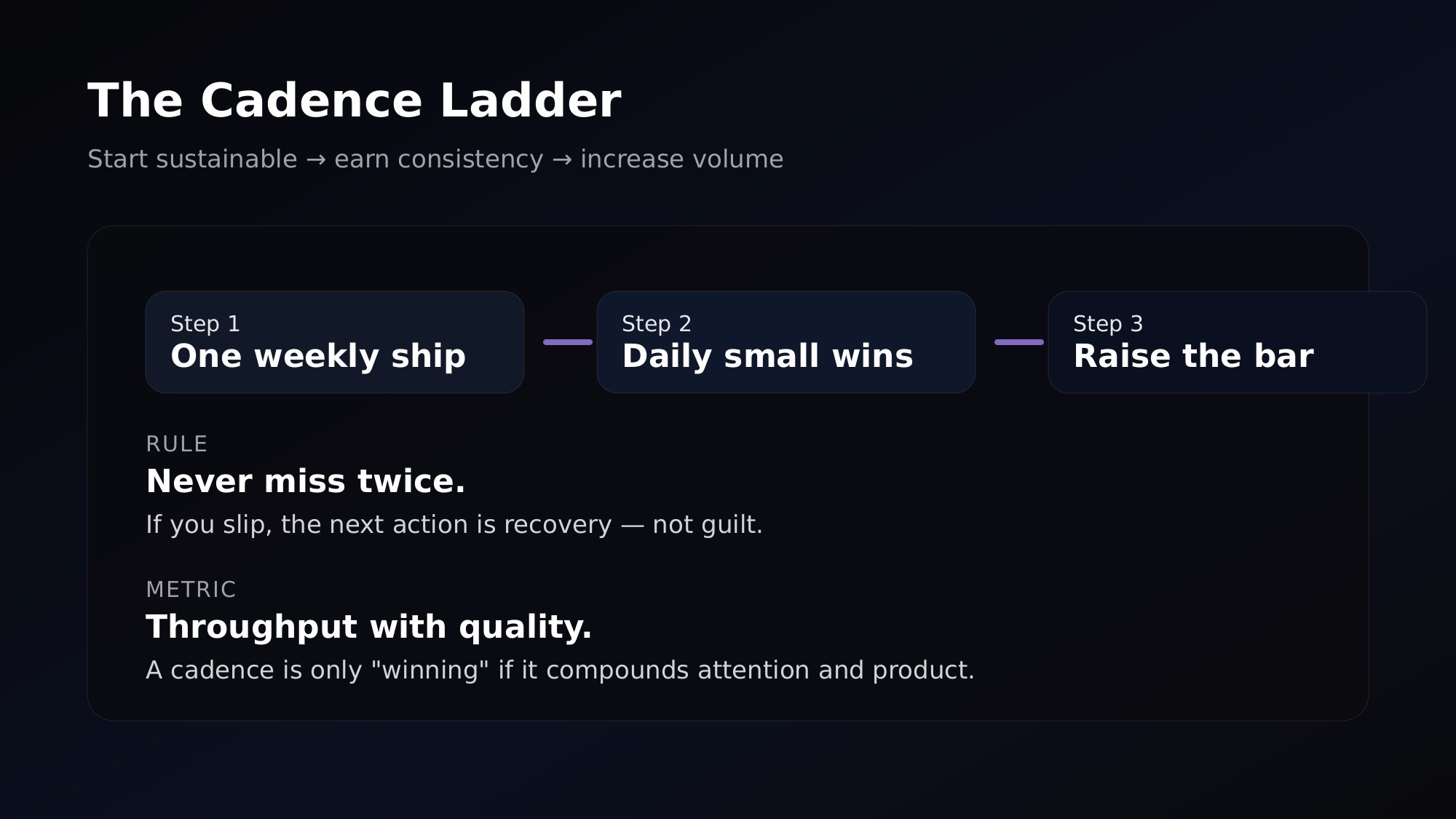
Step 1 — One weekly ship
Pick a single weekly “ship day.” Treat it like payroll.
This is where you build trust with yourself.
Rule: the shipment must be visible.
Examples:
- A performance improvement users can feel
- A new onboarding step
- A pricing page rewrite
- A bug fix that removes friction
Invisible work is important — but if all your work is invisible, users can’t learn to trust your momentum.
Step 2 — Daily small wins
Once weekly shipping is stable, add daily wins.
Not big. Not heroic.
Small and shippable.
- one UI polish
- one conversion fix
- one content improvement
- one support issue solved permanently
Daily wins create identity: “We are a team that ships.”
Step 3 — Raise the bar
Only after you’ve proven Step 1 and Step 2 for a few weeks do you raise volume.
Not because you need more output — but because you’ve earned the right to scale.
Here’s the guardrail I use:
Never miss twice.
Missing once is life.
Missing twice is a system failure.
If you miss, the next action is recovery — not guilt.
A weekly rhythm you can keep (even when you’re tired)
This is the rhythm I recommend to founders who want quality without chaos:
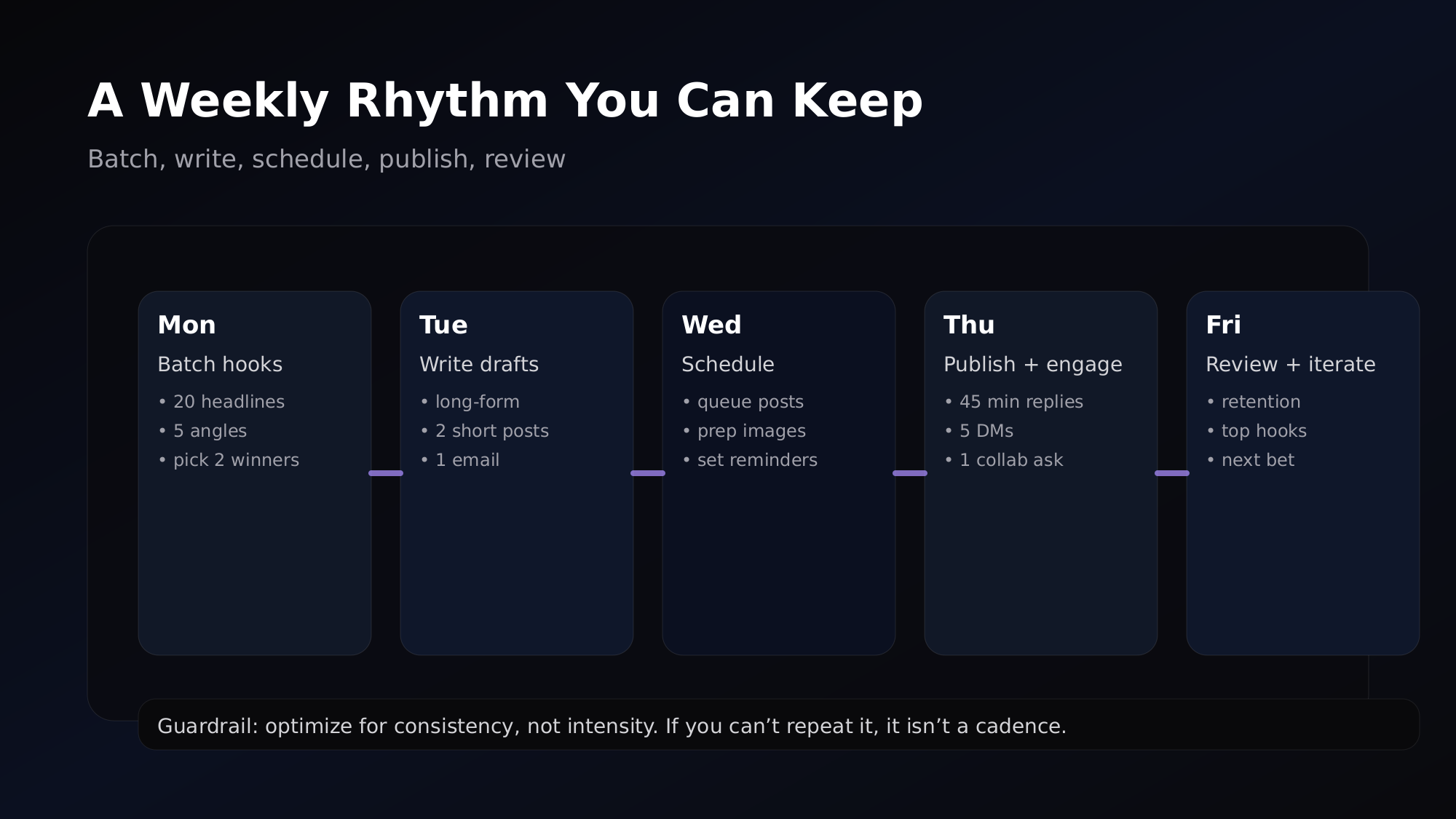
Monday: batch hooks + decisions
Monday is for thinking, not typing.
- Write 20 hooks/headlines.
- Pick 2 angles worth exploring.
- Decide what this week’s “ship” is.
If you don’t decide early, you’ll spend the week debating.
Tuesday: write + build the core asset
Tuesday is for making the asset real.
- Draft the long-form post / release note.
- Build the product change behind it.
- Capture screenshots, diagrams, before/after.
Wednesday: schedule + packaging
Wednesday is for polish and packaging.
- Turn ideas into clean posts.
- Prepare images.
- Schedule distribution.
A premium brand is simply a brand that respects details.
Thursday: publish + engage
Thursday is for shipping and being present.
- Publish the change.
- Spend 30–60 minutes replying to people.
- Do one outbound ask (collab, intro, podcast, customer call).
Your work doesn’t compound if nobody sees it.
Friday: review + tighten the loop
Friday is for learning.
- What performed?
- What converted?
- What was ignored?
- What should we do less of?
Leaders don’t just move. They steer.
The “premium” standard: what you’re really trying to protect
A winning cadence protects three things:
- Quality — you’re building a brand, not just shipping code.
- Clarity — everyone knows what matters this week.
- Confidence — your team feels progress, not panic.
Here’s a simple definition that keeps teams honest:
A cadence is winning when it improves trust faster than it consumes energy.
If your cadence produces output but drains belief, it’s not winning.
What current AI research teaches us about shipping (4 concrete takeaways)
I wasn’t able to use the Bird (X/Twitter) feed in this environment because credentials aren’t configured, so I used primary sources directly.
1) “More agents” isn’t automatically better — architecture matters
Google Research evaluated 180 agent configurations and found that multi-agent systems can help a lot on parallel tasks — but can hurt badly on sequential ones.
- Centralized coordination improved performance by 80.9% on parallelizable finance tasks.
- On sequential planning tasks, multi-agent variants degraded performance by 39–70%.
Leadership lesson: don’t add process because you feel behind. Add process only when the task structure demands it.
Sources:
- Google Research: Towards a science of scaling agent systems https://research.google/blog/towards-a-science-of-scaling-agent-systems-when-and-why-agent-systems-work/
- Paper (arXiv): https://arxiv.org/abs/2512.08296
2) Multilingual scaling has a “compute tax” — plan for the cost of breadth
ATLAS studied 774 training runs across 400+ languages, showing the “curse of multilinguality” is real — but manageable with explicit scaling rules.
One practical rule-of-thumb from their fitted scaling law:
- to support ~2× languages, increase model size by ~1.18× and total data by ~1.66×.
Leadership lesson: breadth costs. If you expand scope, you must expand capacity — or you’ll quietly degrade quality.
Sources:
- Google Research: ATLAS: Practical scaling laws for multilingual models https://research.google/blog/atlas-practical-scaling-laws-for-multilingual-models/
- Paper (PDF): https://arxiv.org/pdf/2510.22037
3) Small models can win with decomposition — systems beat raw horsepower
Another Google Research paper shows a two-stage decomposition (summarize screens → extract intent) can let small on-device models achieve results comparable to larger models, while reducing latency/cost and privacy risk.
Leadership lesson: when you can’t afford “bigger,” get “smarter.” Break the work into stages your system can handle.
Sources:
- Google Research: Small models, big results… https://research.google/blog/small-models-big-results-achieving-superior-intent-extraction-through-decomposition/
- EMNLP 2025 paper: https://aclanthology.org/2025.emnlp-main.949/
4) Sampling matters — you can buy speed without buying chaos
GIST (Greedy Independent Set Thresholding) improves dataset subset selection by balancing diversity and utility, with provable guarantees.
Leadership lesson: better selection beats brute force. The same is true for your roadmap: pick the right few bets and execute them well.
Sources:
- Google Research: Introducing GIST https://research.google/blog/introducing-gist-the-next-stage-in-smart-sampling/
- Paper (arXiv): https://arxiv.org/abs/2405.18754
How to apply this tomorrow (a practical checklist)
If you want this to be real by next week, do this:
- Pick your ship day. Put it on the calendar.
- Choose a visible deliverable. If nobody can see it, it doesn’t count.
- Write Monday’s decision doc: what we ship, why it matters, what “done” means.
- Create a Friday review ritual: one page: what worked, what didn’t, what we change.
- Adopt one guardrail:
- “Never miss twice.”
- “If it can’t ship in a week, it’s not this week.”
If you do only one thing, do this:
Make your cadence a promise you can keep.
Because a team that keeps promises becomes a team people bet on.
And compounding is simply what happens when trust meets time.


