Most teams don’t lose because they lack talent.
They lose because they lack cadence.
Somewhere between “we should improve the UX” and “let’s rewrite the whole thing,” momentum dies. The to-do list grows. The confidence shrinks. And premium polish becomes a yearly aspiration instead of a daily habit.
Here’s the leadership principle that changed how I build:
If you can’t ship it in 15 minutes, you don’t understand it yet.
Not everything has to ship in 15 minutes. But every day should contain 15-minute ships.
This post is the operating system we’re using for musayer.com (JarvisAI): a loop that produces Apple-level polish through small, relentlessly consistent improvements.

The loop (one bet, one metric, one ship)
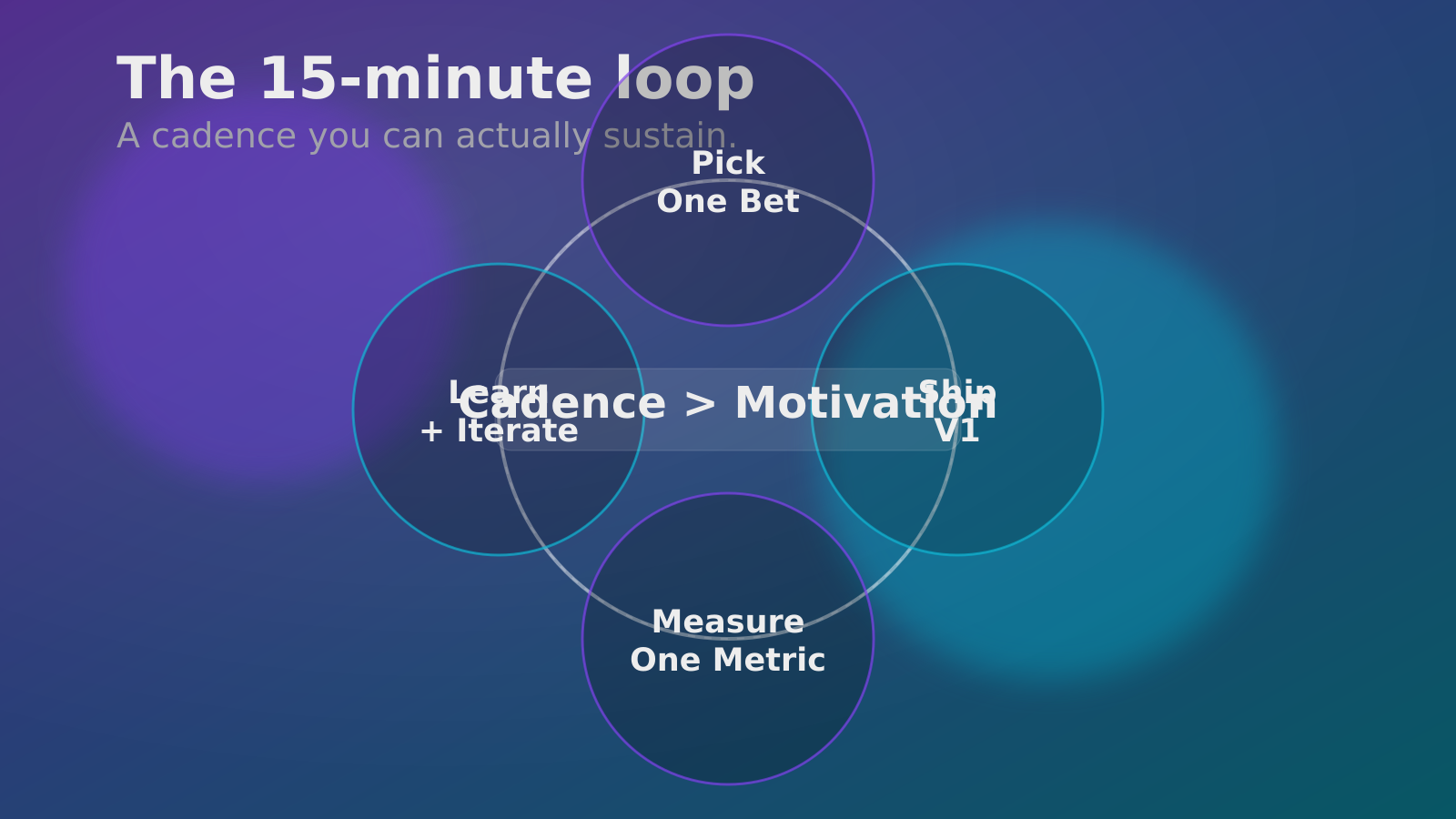
A 15-minute loop has four moves:
- Pick one user goal (not “improve the product”)
- Place one product bet tied to one metric
- Ship one V1 improvement (1–3 changes, max)
- Measure, learn, and iterate (write it down)
That’s it. Simple on paper. Hard in practice—because it forces clarity.
And clarity is leadership.
Why 15 minutes?
Because 15 minutes is short enough to avoid “committee gravity,” but long enough to produce real quality when the scope is right.
When you tighten the timebox, you automatically:
- choose smaller bets
- reduce risk
- ship more often
- learn faster
- build trust with users
Premium products aren’t built by heroic sprints.
They’re built by repeatable loops.
Start with the user goal (one sentence)
A user goal is not a feature.
A user goal is a desire that someone has when they land on your site.
Examples:
- “Understand what JarvisAI does in 7 seconds.”
- “Decide whether this is trustworthy.”
- “Feel confident enough to join the waitlist.”
- “Skim a blog post and get 3 actionable takeaways.”
Leadership move: write the goal in plain language.
If you can’t explain it simply, you’re not ready to ship.
Place one bet tied to one metric
A product bet is a hypothesis.
Not “let’s add a dashboard.”
A bet is: “If we do X, then Y will happen, because Z.”
Examples of good small bets:
- “If we add a clearer value proposition above the fold, then more users will scroll to ‘How it works,’ because they understand the promise.”
- “If we add real screenshots to the blog posts, then time-on-page will increase, because the content feels concrete.”
- “If we tighten spacing and typography consistency, then conversion will improve, because the site feels premium and trustworthy.”
Pick one metric for the bet:
- click-through to CTA
- waitlist conversion
- scroll depth
- time on page
- bounce rate
Leadership principle: one bet, one metric keeps the team honest.
Ship a V1 (yes, even if it’s imperfect)
Most teams delay shipping because they’re aiming at “final.”
But “final” is a mirage.
Premium is not a single release. Premium is what you do repeatedly.
So ship the V1 that’s:
- correct
- cohesive
- measurable
- reversible
Then iterate.
The 5-line operating system

Print it. Put it next to your keyboard.
- One user goal
- One bet tied to one metric
- One shippable change
- One feedback signal
- Write what you learned
Do this often enough and you stop “planning to be premium.”
You become premium.
What’s happening in AI right now (and why it reinforces the loop)
I tried to use Bird (X/Twitter CLI) to scan trending threads for this post, but the environment running this build didn’t have X cookies configured—so instead I pulled directly from primary RSS sources (OpenAI + Google) and kept takeaways tightly grounded in what they published.
Here are the patterns worth noticing:
1) Agents are getting real—and safety is moving from theory to practice
OpenAI published guidance focused on keeping data safe when an AI agent clicks a link.
Takeaway: when products become agentic, UX and security merge. The “polish” isn’t just aesthetics—it’s safe defaults, clear permissioning, and predictable behavior.
Source: OpenAI — “Keeping your data safe when an AI agent clicks a link” https://openai.com/index/ai-agent-link-safety
2) The agent loop is becoming a first-class product concept
OpenAI also published on the structure of an agent loop (“Unrolling the Codex agent loop”).
Takeaway: users don’t just want outputs; they want reliable loops: plan → act → check → recover.
Your product loop and your AI’s agent loop should rhyme.
Source: OpenAI — “Unrolling the Codex agent loop” https://openai.com/index/unrolling-the-codex-agent-loop
3) AI experiences are shifting toward “just ask” simplicity
Google highlighted a “seamless new Search experience” that emphasizes asking naturally.
Takeaway: the competitive advantage is increasingly interaction design. The product that wins is the one that makes power feel effortless.
Source: Google — “Just ask anything: a seamless new Search experience” https://blog.google/products-and-platforms/products/search/ai-mode-ai-overviews-updates/
4) AI is becoming subscription-shaped and globally distributed
Google also announced expanded availability for its AI subscription plan.
Takeaway: distribution is a feature. If users can’t easily access, understand, and pay for it, capability doesn’t matter.
Source: Google — “Google AI Plus is now available everywhere our AI plans are available, including the U.S.” https://blog.google/products-and-platforms/products/google-one/google-ai-plus-availability/
5) Benchmarks are being democratized (and that’s a product opportunity)
Google announced community benchmarks on Kaggle.
Takeaway: evaluation isn’t just for researchers anymore. Users want evidence and comparability—and products can build trust by exposing lightweight, understandable measures.
Source: Google — “Introducing Community Benchmarks on Kaggle” https://blog.google/innovation-and-ai/technology/developers-tools/kaggle-community-benchmarks/
How this translates into premium website improvements
Premium polish is rarely one big change. It’s dozens of small ones.
Here’s how to use the 15-minute loop on a marketing site:
Bet types that ship fast (and compound)
- Typography consistency: tighten letter spacing, line-height, heading scale
- Spacing rhythm: one spacing system (8px/12px/16px) across sections
- CTA clarity: one action per section, with supportive microcopy
- Trust assets: logos, quotes, numbers—real and verifiable
- Performance: smaller images, fewer blocking scripts, better LCP
- Content quality: better structure, better examples, better visuals
A leadership trick: lower the ego, raise the standard
The proudest teams often ship the slowest.
Because pride says:
- “It has to be perfect.”
- “Let’s wait until the redesign.”
- “We’ll do content later.”
Leadership says:
- “Ship the next right thing.”
- “Make it cohesive.”
- “Make it measurable.”
Premium is not fragile.
Premium is disciplined.
Your next 15 minutes
If you want to try this cadence today, here’s the simplest possible start:
- Pick one page (home or blog)
- Pick one user goal
- Pick one metric
- Ship one change in 15 minutes
- Write down what you learned
And then do it again.
Because the real secret isn’t brilliance.
It’s consistency with standards.
That’s how premium gets built.


